

What Is the Best Massage for Office Workers?
Best Massage for Office Workers: Personalized Relief for Work-Related Tension
Sitting at a desk for eight hours straight does more damage than most people realize. Your neck cranes forward. Your shoulders round. Your lower back compresses under the weight of poor posture.
The tension builds gradually. By mid-afternoon, stiffness sets in. By evening, pain becomes constant. The question isn't whether office work causes problems. It's a question of which type of massage actually fixes them.
Not all massage addresses the specific patterns desk work creates. Here's what works best for different office-related issues and why the right approach makes all the difference.
What Is the Best Massage for Office Workers?
The best massage for office workers depends on which problem needs fixing
Office work doesn't create one universal pattern. Someone who types all day develops different tension than someone in back-to-back video calls. Wrist pain requires different treatment than lower back compression.
The most effective approach combines techniques based on individual assessment.
Deep tissue reaches chronic tightness in muscle layers.
Trigger point therapy deactivates knots that refer pain elsewhere.
Myofascial release addresses connective tissue restrictions.
Generic sessions apply the same routine regardless of actual problems. Targeted treatment allocates time where tension actually exists.
The best massage for office workers is the one that addresses specific imbalances rather than following a predetermined sequence. Here's how different massage techniques can help with common desk-related issues at the office.
5 Best Massage Types for Specific Office Worker Problems
1. Deep Tissue Massage for Neck and Shoulder Tension (Tech Neck)
Forward head posture strains the muscles at the base of the skull and along the neck. Every inch the head moves forward adds 10 pounds of pressure these muscles must support.
Deep tissue massage targets the upper trapezius, levator scapulae, and suboccipital muscles. These areas accumulate chronic tension from looking down at screens or hunching toward monitors for hours each day.
The pressure reaches layers that lighter touch cannot access. Adhesions form over months in these chronically tight areas, and breaking them up requires sustained, focused pressure.
This technique works especially well for people whose neck and shoulders bear most of the strain from desk work. The relief often extends beyond the neck itself—many people notice their tension headaches decrease once the underlying muscle strain gets addressed.
2. Trigger Point Therapy for Shoulder and Upper Back Knots
Muscles that stay contracted for long periods develop knots called trigger points. What makes these tricky is how they create pain in places far from where the actual knot exists.
A trigger point lodged in the shoulder blade might send pain shooting up the neck or down the arm. Applying focused pressure to deactivate that specific spot eliminates discomfort in multiple areas at once.
The trigger point therapy involves holding steady pressure on each trigger point until the muscle finally releases. This takes time and precision because rushing through these spots provides minimal lasting relief.
Office workers who feel specific knots between their shoulder blades or experience that familiar tightness in the same spots day after day respond particularly well to this approach.
3. Myofascial Release for Lower Back Pain from Sitting
Sitting for hours shortens the hip flexors and creates restrictions in the fascia that surrounds muscles. This connective tissue becomes stiff and less pliable when held in the same position repeatedly.
Myofascial release uses sustained pressure combined with stretching to restore how the tissue moves. The focus stays on the quadratus lumborum, psoas, and iliacus—muscles that tighten up from spending most of the day in a chair.
The technique feels different because fascia responds slowly. Pressure holds longer than in typical massage, and the pace stays deliberately slow to give the tissue time to change.
People dealing with lower back pain that gets worse after sitting for several hours see the best results. The work addresses the restrictions pulling on the pelvis and compressing the lumbar spine rather than just temporarily loosening surface muscles.
4. Sports Massage for Wrist and Forearm Pain (Repetitive Strain)
Constant keyboard and mouse use creates overuse patterns remarkably similar to what athletes develop from repetitive training. Sports massage techniques handle these cumulative stress injuries effectively.
The treatment includes friction therapy on the forearm muscles, cross-fiber strokes that break up adhesions, and stretching to restore full range of motion. Importantly, the work extends well beyond the wrists to include the entire arm and shoulder girdle.
This matters because nerve compression often starts up in the neck or chest rather than at the wrists themselves. Sports massage addresses the full chain of muscles and nerves instead of treating one isolated area and hoping for the best.
Office workers who type for hours daily or spend significant time using a mouse benefit from catching these patterns early. The technique stops minor discomfort from progressing into chronic conditions like carpal tunnel syndrome.
5. Swedish Massage with Postural Focus for General Tension and Stress
Swedish massage uses flowing strokes and lighter pressure aimed primarily at relaxation. While it does not reach the deeper chronic tension layers, it effectively reduces stress and improves circulation throughout the body.
Adding a postural focus means the therapist targets areas most affected by sitting. This includes spending extra time on the chest muscles, hip flexors, and other areas that shorten from desk work, even while keeping the overall pressure lighter.
This variation works well for office workers whose main complaint is stress rather than severe pain. The gentler pressure feels more comfortable for people new to massage or those who find deeper work too intense.
Consider this more of a maintenance approach. It prevents minor tension from building into major problems, though it does not address existing chronic conditions as effectively as techniques that work deeper tissue layers.
Custom Massage vs Other Massage Types for Office Workers
Custom massage for office workers combines multiple techniques based on individual assessment rather than following one predetermined approach.
Assessment reveals patterns. A therapist examines posture, tests range of motion, and identifies which muscles are overworked. Treatment blends deep tissue, trigger point therapy, myofascial release, and stretching based on findings.
Time gets allocated where problems exist. Someone with severe neck tension might need 30 minutes of upper body work. Another person might need concentrated lower back and hip treatment.
Standard sessions apply the same routine to everyone. Custom treatment adapts to actual needs.
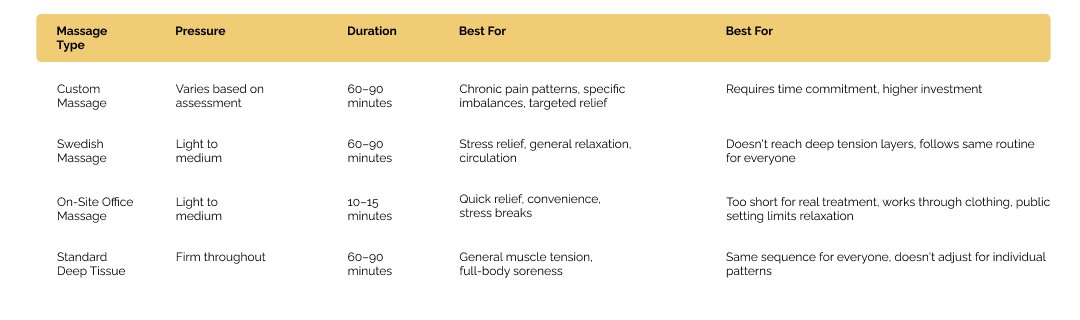
Swedish Massage
Swedish massage uses lighter pressure for relaxation. Long, flowing strokes increase circulation and reduce stress.
Works well for:
Stress management and general wellness
People new to massage
Those with lower pain tolerance
Maintaining mobility between deeper sessions
Doesn't address:
Chronic tension layers that build from months of desk work
Specific postural imbalances
Deep muscle restrictions
Root causes of pain patterns
Most office workers need more targeted pressure to release restrictions that accumulate over time.
On-Site Office Massage
Chair massage at work offers convenience. Sessions last 10 to 15 minutes and therapists work through clothing in shared spaces.
Benefits:
No travel time during busy workdays
Quick tension relief between meetings
Good for stress breaks
Builds awareness of where tension exists
Limitations:
Time constraint prevents comprehensive treatment
Clothing blocks effective deep tissue work
Public setting prevents full relaxation
No postural assessment or customization
Can't reach deeper muscle layers
Standard Deep Tissue
Standard deep tissue applies firm pressure across major muscle groups following the same sequence for every client.
Provides:
Relief for general muscle soreness
Deeper pressure than Swedish massage
Full-body tension reduction
Consistent routine some people prefer
Limitations:
Same sequence regardless of individual needs
No assessment of specific imbalances
Equal time on all areas whether needed or not
Doesn't adapt to tissue response
Custom deep tissue starts with assessment and adjusts based on findings. The pressure, technique, and time allocation change according to what tissues actually need.
What to Expect During Your Custom Massage Session
Before the Session
The intake form covers work setup, pain locations, and which movements cause discomfort. Arrive in comfortable clothing. The therapist needs to observe posture and range of motion.
During the Session
Assessment happens first. The therapist examines posture, checks mobility, and identifies where tension concentrates.
Discussion clarifies priorities. Full-body work or concentrated attention on specific areas.
Treatment adapts based on what tissues need. Techniques blend throughout the session. Myofascial release on hip flexors might transition to deep tissue on the lower back, then trigger point work on the shoulders.
After the Session
Stretches and ergonomic recommendations help maintain results between sessions. The therapist might suggest monitor height adjustments, keyboard positioning changes, or specific stretches to do throughout the workday.
Frequency recommendations depend on severity. Acute pain often needs weekly sessions for three to four weeks. Chronic tension benefits from bi-weekly maintenance. Prevention might only require monthly visits.
At Mudras in Chelsea, NYC, our therapists specialize in custom massage for New York professionals dealing with work-related tension. Sessions address individual patterns and create plans that target root causes rather than providing temporary relief.
How Often Should Office Workers Get a Massage?
For Acute Pain or New Issues
Weekly sessions for three to four weeks break the pain cycle before it becomes chronic. Consistent treatment retrains muscles to release tension rather than holding patterns.
Acute pain responds fastest to concentrated attention. Spacing sessions too far apart allows problems to return between treatments.
For Chronic Tension
Bi-weekly sessions maintain progress once acute pain resolves. This frequency prevents backsliding while giving the body time to adapt between treatments.
Chronic patterns took months or years to develop. Reversing them requires ongoing work even after initial relief.
Pairing sessions with ergonomic adjustments and daily stretching extends results. Massage addresses existing tension. Better habits prevent new buildup.
For Prevention and Wellness
Monthly sessions work well once major issues are resolved. Regular treatment catches small problems before they become chronic conditions.
Prevention is easier than correction. Maintaining mobility and releasing minor tension before it accumulates requires less intensive work.
Frequency also depends on stress levels and whether self-care happens between sessions. High-stress periods might need more frequent work. People who stretch daily might need less.
Ergonomic Tips to Extend Your Results
Workspace Setup
Position the monitor at eye level so the head doesn't tilt down. Keep the keyboard and mouse within easy reach to avoid shoulder strain. Choose a chair that supports the natural curve of the lower back.
Feet should rest flat on the floor or a footrest. Dangling feet create hip and lower back tension.
Small adjustments make significant differences over eight-hour workdays. Proper setup prevents the cumulative damage that requires intensive treatment.
Movement Breaks
Stand and walk every 30 to 60 minutes. Static positions create more problems than the actual posture. Movement prevents muscles from locking into shortened positions.
Simple stretches help between breaks. Shoulder rolls release upper back tension. Neck stretches in all directions maintain mobility. Hip flexor stretches counteract sitting's effects.
Posture Reminders
Set hourly alerts as reminders to check positioning. Imagine a string pulling the head toward the ceiling. Draw shoulders down and back without forcing an unnatural arch.
Awareness matters more than perfect posture. Noticing when slouching begins allows quick corrections before tension builds.
Micro-Exercises at Your Desk
Chin tucks strengthen neck muscles that fight forward head posture. Scapular squeezes activate the muscles between shoulder blades that get overstretched. Wrist circles maintain mobility for people who type constantly.
These exercises take seconds and prevent the buildup that leads to chronic pain. Consistency matters more than intensity.
Mudras therapists provide personalized ergonomic recommendations based on assessment findings. What helps one person might not address another's specific imbalances.
The Bottom Line
The best massage for office workers depends on which problems need addressing. Neck tension responds to deep tissue work. Knots require trigger point therapy. Lower back pain needs myofascial release. Wrist issues benefit from sports massage techniques.
Custom massage combines these approaches based on individual assessment. Treatment addresses root causes rather than following generic routines that might miss actual problem areas.
Ready to experience relief from work-related tension? Book a custom massage session in NYC at Mudras and discover which techniques work best for your specific office-related issues.