

What Is Myofascial Release? How It Works and Who Needs It
Tight muscles aren't always the problem. Sometimes it's the tissue wrapped around them. Your body has connective tissue called fascia covering every muscle. When fascia gets tight, it restricts movement. Your muscle can't do what it's supposed to do. You lose mobility. Pain develops. Regular massage targeting the muscle doesn't fix it.
Myofascial release works on fascia directly. Understanding what fascia is, why it gets tight, and how myofascial release helps you move better makes sense of why some muscle tightness doesn't respond to regular massage.
This guide covers what fascia is, how myofascial release differs from other massage types, who benefits, and when it works best.
What Is Fascia and Why It Restricts
Fascia is connective tissue wrapping around muscles. Think of it like plastic wrap covering your muscles. Healthy fascia is flexible. Tight fascia limits movement.
Fascia tightens from repetitive movement, poor posture, training patterns, or old injuries. A runner's IT band gets tight fascia from running. Office workers develop tight fascia in hips and lower back from sitting. Athletes get fascia restrictions from the same movements over and over.
When fascia gets tight, it pulls on everything around it. A tight hip creates knee problems. Tight calves restrict ankle mobility. Tight shoulders limit arm movement. The problem isn't the muscle. It's the tissue wrapping around it.
Standard deep tissue massage works on muscle. Myofascial release specifically targets fascia. Fascia needs different pressure and technique than muscle. It needs sustained pressure, not aggressive crushing. It needs slow, deliberate work, not rapid movement.
Who Benefits From Myofascial Release
Athletes dealing with fascia restrictions limiting performance. A runner's tight IT band fascia loses stride efficiency. A swimmer's tight shoulder fascia limits arm movement. Myofascial release restores normal function.
People who can't move the way they want because fascia is tight. Hip fascia tightness limits hip movement. Shoulder fascia limits reaching overhead. This isn't weakness. It's mechanical restriction from tight fascia.
People with chronic pain where fascia tightness is the underlying cause. Addressing the fascia restriction removes what's creating the pain rather than just managing symptoms.
Recovery from injury or surgery where scar tissue creates fascia restrictions. As you heal, tight fascia develops. Myofascial release addresses this as healing progresses.
People with postural problems where fascia gets chronically tight. Forward shoulder posture tightens chest and shoulder fascia over time. Myofascial release removes the restriction. Postural work prevents it from returning.
Examples: Fascia Problems and Solutions
Runner with Tight IT Band
What's happening: IT band fascia is restricted. This limits hip movement and creates knee tracking issues.
How myofascial release helps: Sustained pressure on the tight fascia slowly releases it. Combined with mobility work getting the hip moving properly again.
Result: Stride feels normal. Knee pain goes away.
Shoulder Movement Restriction
What's happening: Shoulder and chest fascia is tight. Reaching overhead is limited. Arm movement feels restricted.
How myofascial release helps: Slow, sustained pressure on shoulder and chest fascia releases the tightness. Mobility exercises maintain the gains.
Result: Full overhead movement returns. Tightness disappears.
Tight Hips from Office Work
What's happening: Hip flexor fascia gets tight from sitting. Lower back compensates and hurts. Hip movement is limited.
How myofascial release helps: Sustained pressure on hip flexor and hip fascia releases restrictions. Stretching and mobility work prevent return.
Result: Hips move freely. Lower back pain goes away.
Restricted Movement After Surgery
What's happening: Healing creates scar tissue and tight fascia around the surgical area. Movement is mechanically limited.
How myofascial release helps: Gentle myofascial release as healing allows. Gradually addresses fascia restrictions as tissues heal.
Result: Scar tissue becomes mobile. Normal movement returns.
Myofascial Release vs. Deep Tissue
Deep tissue uses deeper pressure to break up muscle tightness and adhesions. The therapist applies consistent pressure throughout the session. It works for muscles that are tight and locked up.
Myofascial release uses sustained pressure on tight fascia, usually lighter than deep tissue, but held longer. The therapist finds a restriction and holds pressure until the fascia releases. Movement is slow. The goal is releasing fascia, not pounding muscle.
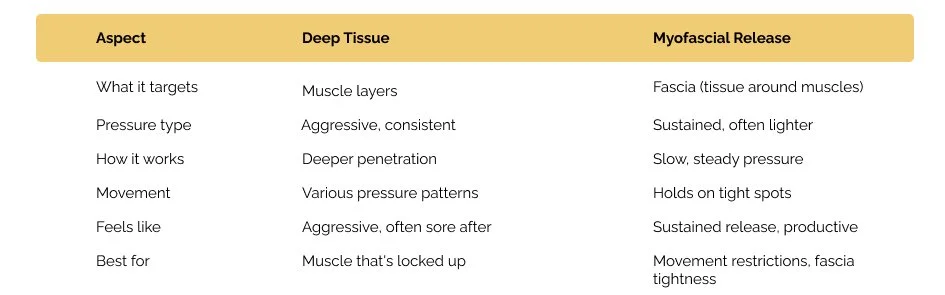
Deep tissue feels more intense. Myofascial release feels like steady pressure slowly releasing. Different problems need different approaches.
Myofascial Release vs. Trigger Point Therapy
Trigger points are tight spots in muscle that create pain somewhere else. A tight spot in your glute creates knee pain. Trigger point therapy finds these spots and releases them.
Myofascial release targets fascia tightness that mechanically restricts movement. Not referred pain from a tight spot. An actual restriction preventing motion.
Many people have both. Tight spots plus fascia restriction. That's when combining both techniques works better than choosing one.
Myofascial Release Combined With Other Techniques
Myofascial release works alongside other massage types when someone has multiple problems. One problem alone is rare. Usually fascia tightness exists with muscle tension, trigger points, or mobility needs.
Myofascial Release Plus Deep Tissue
Runner with tight IT band fascia plus overworked calf muscles. Myofascial release addresses IT band fascia restriction. Deep tissue works the tight calf muscle. Combined approach solves both problems in one session.
Myofascial Release Plus Trigger Point Therapy
Someone with tight hip fascia limiting movement plus a trigger point in the glute creating referred knee pain. Myofascial release removes the fascia restriction. Trigger point therapy deactivates the glute spot. Both problems resolve.
Myofascial Release Plus Stretching
Shoulder fascia restriction limiting overhead reach plus tight shoulder muscles. Myofascial release releases the fascia. Stretching and mobility work restores full range. Combined approach restores normal function faster than either alone.
Myofascial Release Plus Swedish Massage
Chronic pain from fascia restriction plus overall tension and stress. Myofascial release addresses the mechanical restriction. Light Swedish techniques calm the nervous system. Combined approach handles both the structural problem and stress response.
Myofascial Release as a Standalone Treatment
Myofascial release works on its own when fascia tightness is the main problem. If your limitation is purely mechanical restriction from tight fascia, myofascial release releases it and restores movement.
Not everyone needs myofascial release combined with other techniques. Some people just need fascia released.
Finding Myofascial Release in NYC
Look for therapists trained specifically in myofascial release. Not all massage therapists understand fascia work. It requires specific training in how fascia releases differently than muscle.
Book Your Myofascial Release Session in NYC
Fascia restrictions limit movement and create pain that regular massage misses. Myofascial release directly addresses the tissue creating the restriction.
Whether you're an athlete, recovering from injury, dealing with chronic pain, or just want to move better, myofascial release removes what's mechanically stopping you.
Ready to move freely again? Book your myofascial release session and address what's restricting your movement.
FAQs
-
Massage therapy targeting fascia (the tissue wrapping around muscles) rather than the muscle itself. It uses sustained pressure to release tight fascia and restore movement.
-
Deep tissue targets muscle with aggressive pressure. Myofascial release targets fascia with sustained, often lighter pressure. Different tissues need different approaches.
-
You feel sustained pressure on tight spots, but it should feel like productive release, not pain. Tell your therapist if it becomes uncomfortable.
-
Athletes with fascia restrictions, people who can't move the way they want, chronic pain sufferers where fascia is involved, people recovering from injury or surgery, and anyone with postural problems limiting movement.
-
Depends on your situation. Athletes might benefit from weekly during training. People with chronic restrictions might do bi-weekly. Your therapist can recommend based on what you're dealing with.
-
Some improvement right after. Real improvement takes multiple sessions as fascia gradually releases. Most people notice significant change within 4 to 6 sessions.